Google Arts and Culture Sueãƒâ±o De Una Tarde Dominical en La Alameda Central
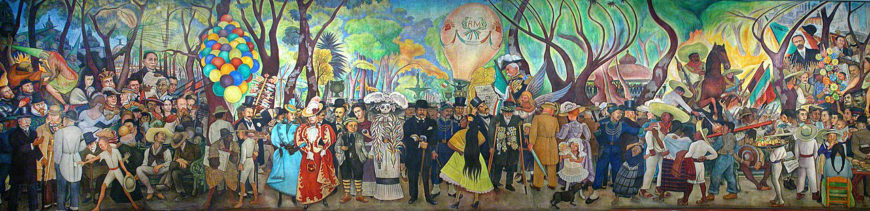
Diego Rivera, Dream of a Sunday Afternoon in Alameda Central Park (Sueño de una tarde dominical en la Alameda Central), 1947, 4.8 x 15 m (Museo Landscape Diego Rivera, originally, Hotel del Prado, Mexico Metropolis; photograph: Fedaro, CC BY-SA 4.0)
Dream or nightmare
In Dream of a Sunday Afternoon in Alameda Central Park, hundreds of characters from 400 years of Mexican history gather for a stroll through United mexican states City's largest park. Just the colorful balloons, impeccably dressed visitors, and vendors with diverse wares cannot conceal the darker side of this dream: a confrontation betwixt an indigenous family and a police officer; a man shooting into the face of someone existence trampled by a horse in the midst of a skirmish; a sinister skeleton smiling at the viewer. What kind of dream, or nightmare, is this?
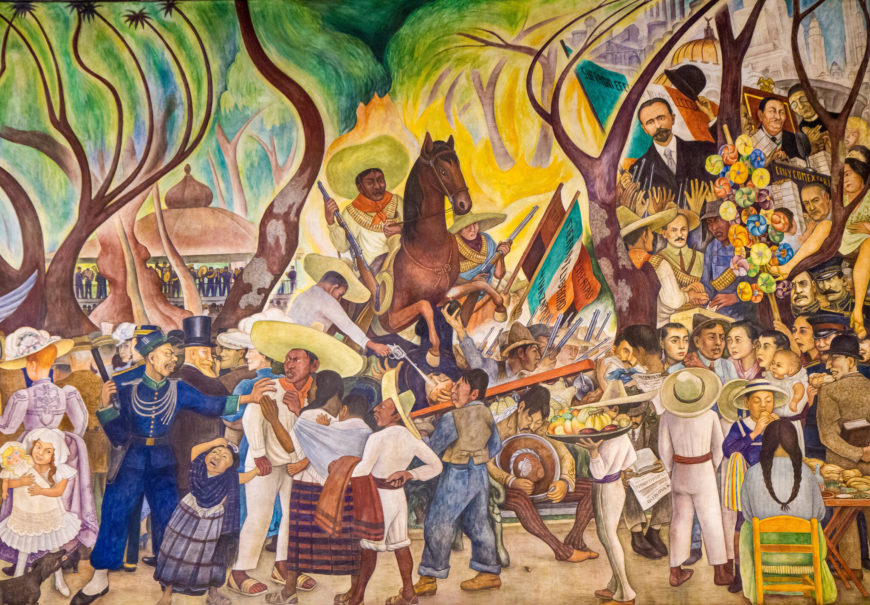
Diego Rivera, detail with rearing horse and shooting, Dream of a Dominicus Afternoon in Alameda Central Park (Sueño de una tarde dominical en la Alameda Cardinal), 1947, 4.eight x xv 1000 (Museo Mural Diego Rivera, originally, Hotel del Prado, United mexican states City; photograph: Garrett Ziegler, CC BY-NC-ND 2.0)
Surreal quartet
In the spirit of Surrealism, this is a complex dream. For Surrealists, like Salvador Dalí, dreams were the principal bailiwick matter. Since dreams are so personal and strange, this immune artists to juxtapose unrelated thing, like clocks and ants for Dalí. Though Rivera never officially joined the Surrealists, he uses this arroyo in Dream of a Dominicus Afternoon in Alameda Central Park as he cobbles together a scene composed of disparate historical personages, including Hernán Cortés (the Spanish conquistador who initiated the fall of the Aztec Empire), Sor Juana (a seventeenth-century nun and one of Mexico's most notable writers), and Porfirio Díaz (whose dictatorship at the turn of the twentieth century inspired the Mexican Revolution).
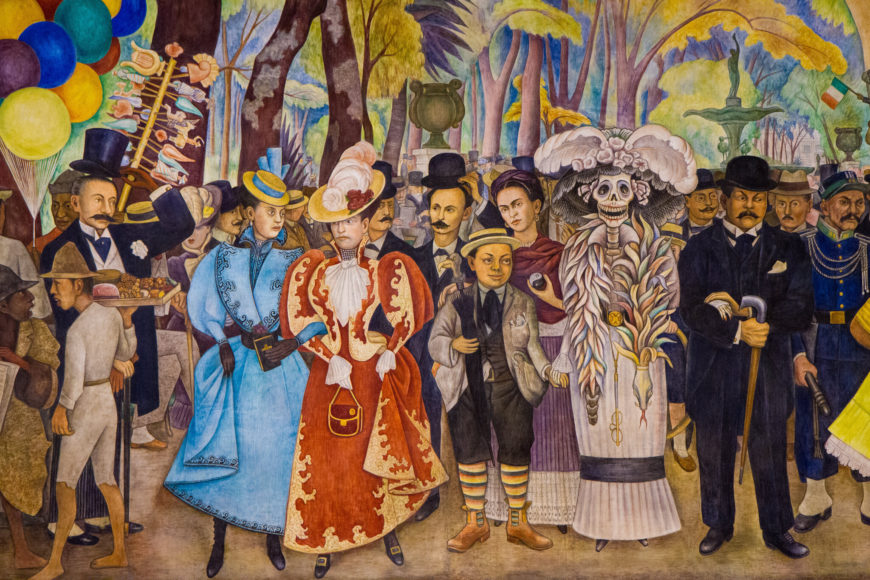
Diego Rivera, detail of central grouping with four rightmost figures (right to left) being the printmaker José Guadalupe Posada (right), La Catrina (the Skeleton), the painter Frida Kahlo (behind La Catrina), and the artist every bit a boyfriend (in front of Kahlo), Dream of a Sunday Afternoon in Alameda Primal Park (Sueño de una tarde dominical en la Alameda Primal), 1947, 4.8 ten 15 m (Museo Mural Diego Rivera, originally, Hotel del Prado, United mexican states City; photo: Garrett Ziegler, CC BY-NC-ND 2.0)
Perhaps the most striking grouping is a fundamental quartet featuring Rivera, the artist Frida Kahlo, the printmaker and draughtsman José Guadalupe Posada, and La Catrina. "Catrina" was a nickname in the early twentieth century for an elegant, upper-class adult female who dressed in European vesture.
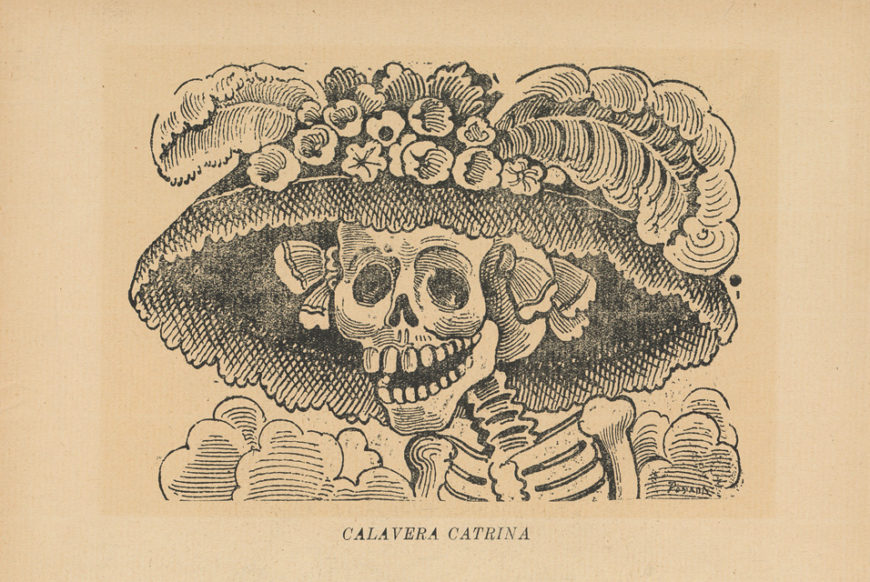
José Guadalupe Posada, La Calavera Catrina, 1913, etching, 34.5 x 23 cm (photograph: Wmpearl, public domain)
This character became infamous in Posada'due south La Calavera de la Catrina (The Catrina Skeleton), 1913. Here, the renowned printmaker depicted La Catrina equally a skeleton in order to critique the Mexican elite. In Dream of a Sunday Afternoon in Alameda Fundamental Park, Rivera reproduces the original Posada impress and adds an elaborate boa—reminiscent of the feathered Mesoamerican serpent god Quetzalcóatl—around her neck.
La Catrina unites 2 great Mexican artists in this mural: she holds Rivera's hand equally her other arm is held by Posada. Though Posada died in obscurity in 1913, artists later brought attention to his work and he was a significant influence on the Mexican muralists. The fourth character in this quartet is Kahlo. She stands behind a child-version of her husband, with i hand protectively on his shoulder as her other holds a Yin and Yang object.
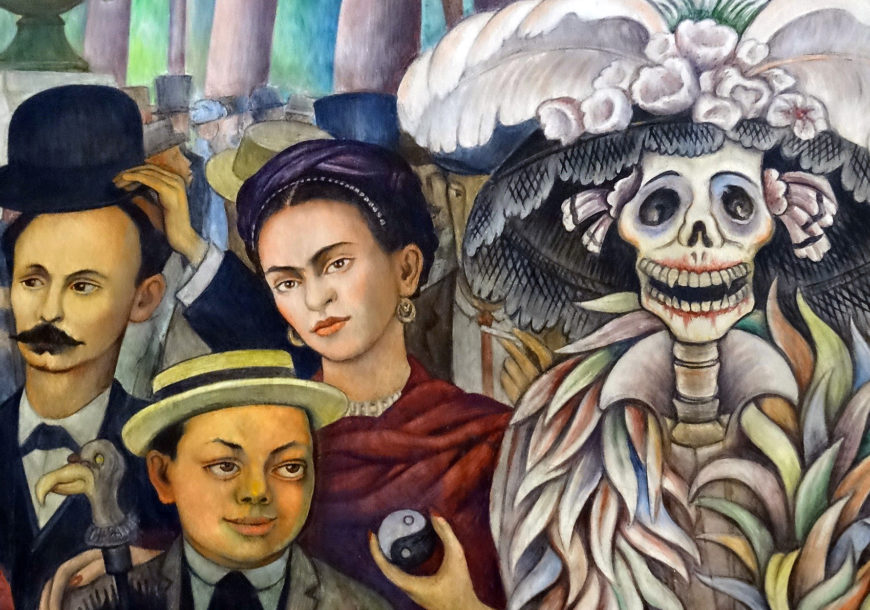
Diego Rivera, detail with the artist every bit a beau (lower left), the paintier Frida Kahlo (behind him), and La Catrina (the Skeleton), Dream of a Sunday Afternoon in Alameda Central Park (Sueño de una tarde dominical en la Alameda Central), 1947, four.8 10 fifteen m (Museo Mural Diego Rivera, originally, Hotel del Prado, United mexican states Urban center; photograph: Adam Jones, CC BY-SA 2.0)
In Chinese philosophy, Yin and Yang refers to opposite yet interdependent forces, like day and night. Within the name of this concept is perhaps the virtually fundamental duality in humanity: female ("Yin") and male ("Yang"). Thus, this Chinese symbol becomes a metaphor for Rivera and Kahlo'south complex human relationship: Rivera began as Kahlo's mentor; they then married, separated, and got dorsum together; they were political comrades; and they painted each other frequently. Their double-portraits frequently reflect the land of the couple'due south relationship at that moment. In Frieda and Diego Rivera (1931) Kahlo subtly plays with the couple'due south stature in society to emphasize Rivera's influence on her. Kahlo was ill equally Rivera worked on this mural and his diminished size may reflect his feelings of helplessness.
Reading Mexican history
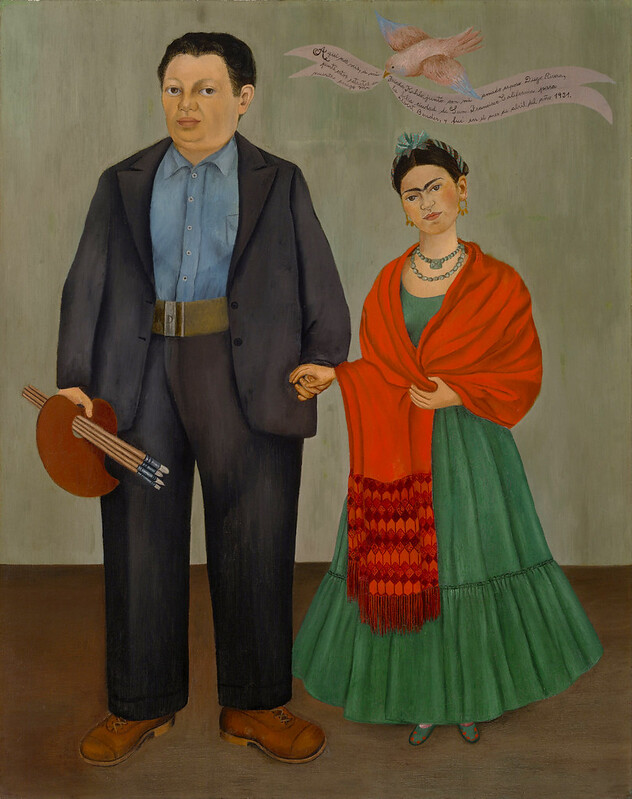
Frida Kahlo, Frieda and Diego Rivera, 1931, oil on sheet, 39–3/8 x 31 inches or 100.01 ten 78.74 cm (San Francisco Museum of Modern Art; photo: Lluís Ribes Mateu, CC BY-NC two.0)
Stepping away from the center, if one reads the mural like a text, a chronology emerges: the left side of the composition highlights the conquest and colonization of Mexico, the fight for independence and the revolution occupy the bulk of the primal space, and mod achievements fill the correct. For some art historians the primal area is a snapshot of conservative life in 1895—every bit refined ladies and gentlemen promenade in their Sun best, under the watchful center of Porfirio Díaz in his plumed military garb. 1 gets a sense of the inequality that stirred boilerplate Mexicans to overthrow their dictator and initiate the Mexican Revolution which lasted from 1910 until 1920.
In this low-cal we tin can appreciate the dreams and nightmares within each epoch. To the left of the balloons the nightmares of the conquest and religious intolerance during the colonial-era give manner to the dream of a democratic nation during the nineteenth century, represented by the over-sized figure of Benito Juárez, who restored the republic after French occupation and attempted to modernize the land as president. On the correct of the composition, beyond the bandstand, the battles of the revolution give mode to a society where "country and freedom," as championed by the workers' flags, becomes a tangible reality.
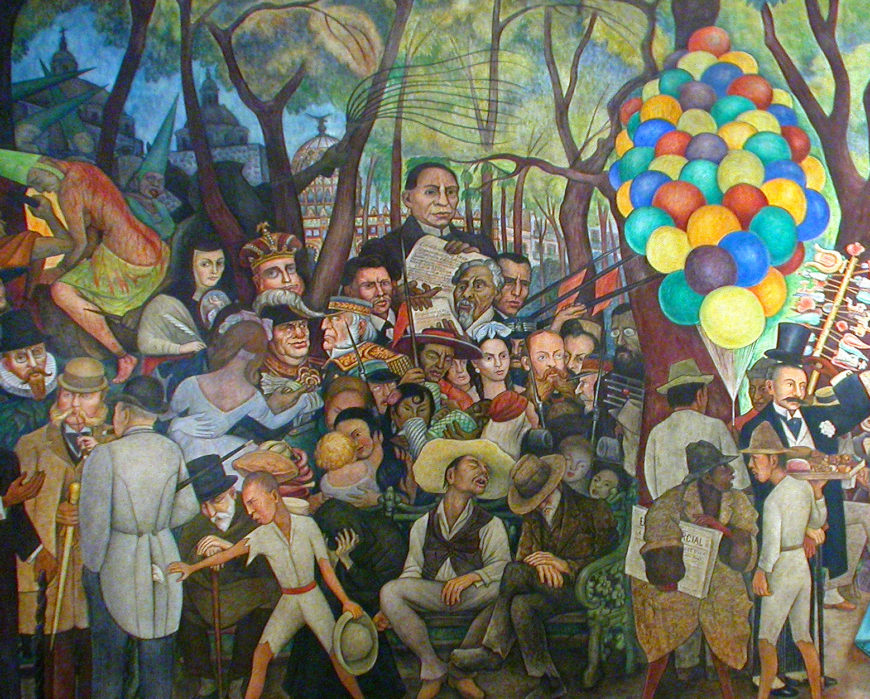
Diego Rivera, particular with Benito Juárez top center, Dream of a Sunday Afternoon in Alameda Central Park (Sueño de una tarde dominical en la Alameda Central), 1947, four.viii 10 15 thousand (Museo Mural Diego Rivera, originally, Hotel del Prado, Mexico City; photo: Fedaro, CC By-SA 4.0)
Histories normally edited out
Generally history is written by the victor and thus reflects an incomplete story. Dream of a Sunday Afternoon in Alameda Primal Park is an antidote to this: Rivera guarantees that histories usually edited out (the stories of the ethnic and the masses) have a place in this grand narrative. The artist reminds the viewer that the struggles and celebrity of four centuries of Mexican history are due to the participation of Mexicans from all strata of society.
Additional resources
William Stockton, "Rivera Mural in Mexico Awaits Its New Shelter" in The New York Times, January. 4, 1987
Source: https://smarthistory.org/rivera-dream-of-a-sunday-afternoon-in-alameda-central-park/
0 Response to "Google Arts and Culture Sueãƒâ±o De Una Tarde Dominical en La Alameda Central"
Post a Comment